Operations Core - Singapore
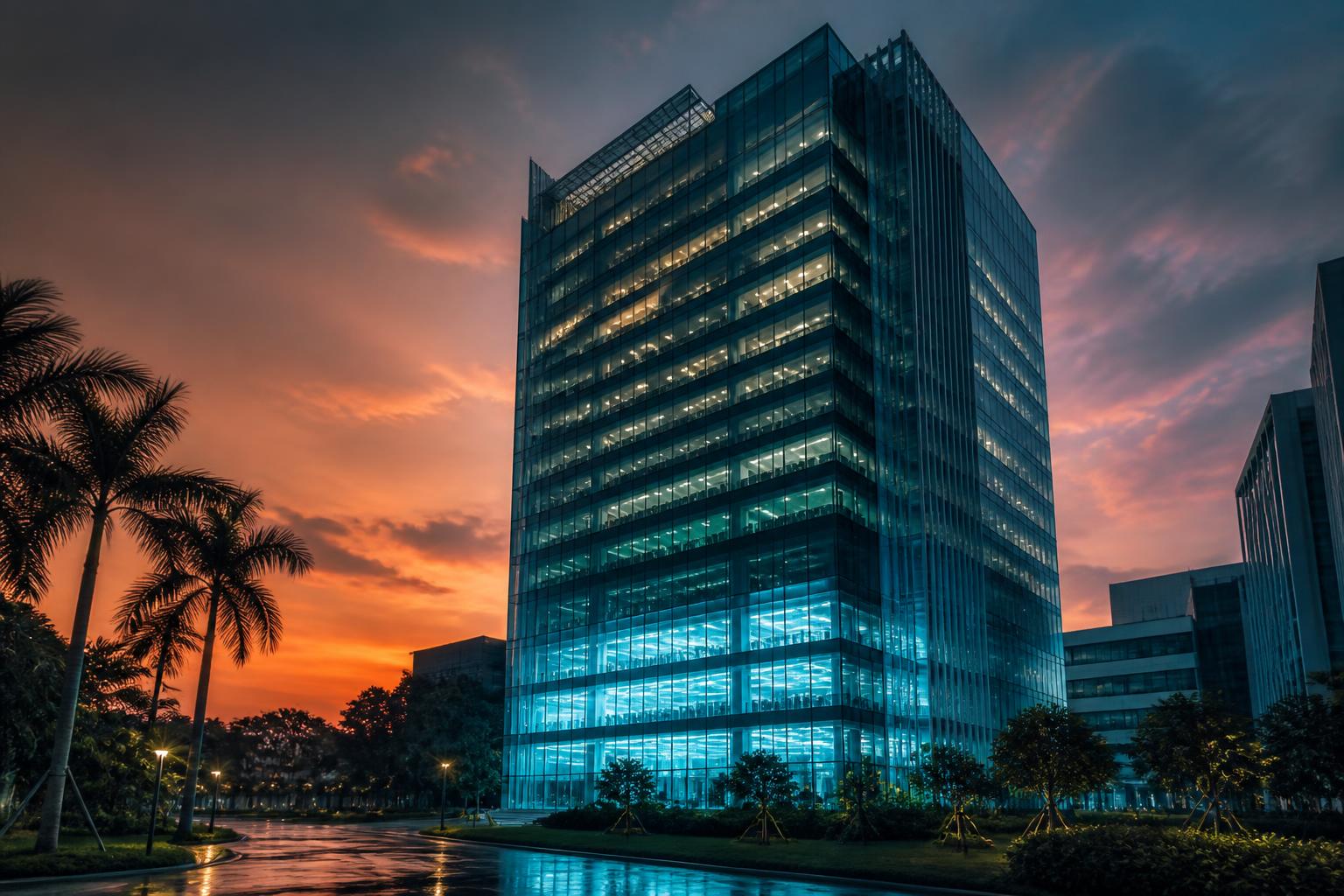
PANOPTICON Directorate Command. A 14-story tower in Singapore's Biopolis research district, officially registered as the "Psyon Asia-Pacific R&D Centre." The facility houses the Director's office, the Watch Floor, the PANACEA primary compute cluster, and — beneath commercial cover — the BSL-4 & Gain-of-Function Vault, Strain Engineering laboratories, and the Neural Implant Bay.
Purpose & Mission
The Singapore Operations Core is the seat of the PANOPTICON Directorate. All strategic decisions, threat assessments, field-operation authorizations, and continuity directives originate from this facility. The tower serves a dual function: the upper floors operate as a credible commercial pharmaceutical R&D centre for Psyon Biosciences' Asia-Pacific division, satisfying regulatory inspections and hosting external partners; the lower floors and sub-levels house the Directorate's classified infrastructure — the Watch Floor, PANACEA core, and the laboratories where the organization's most sensitive programmes are executed.
No other facility in the Directorate network carries this combination of command authority and research capability. Singapore is both the brain and the spine.
Physical Description
The facility occupies a 14-story purpose-built tower at the eastern edge of the Biopolis biomedical research cluster. The structure was designed to Psyon Biosciences specifications and constructed between 2081 and 2083. Externally, the building is indistinguishable from the neighbouring corporate research centres — glass curtain wall, landscaped atrium, visitor reception on the ground floor.
The main tower (floors G–14) is rated BCL-2 and houses the commercial R&D laboratories, meeting suites, the Psyon liaison office, and the upper-floor Directorate offices including the Director's suite. The Watch Floor — a 24/7 command centre with live feeds from the global operations board, PANACEA dashboards, and Vector Fleet telemetry — occupies the entirety of floor 12.
Sub-levels B1 and B2 contain the PANACEA primary compute cluster and the Synaptic Data Fabric core nodes — the infrastructure backbone that feeds every metric, dossier, and dispatch record in the Directorate network. Sub-levels B3 through B5 are rated BCL-4 and house the BSL-4 & Gain-of-Function Vault, Strain Engineering laboratories, and the Neural Implant Bay. These levels are physically isolated from the main tower's HVAC, power, and communications systems.
Key Systems
PANACEA Primary Cluster. The main compute infrastructure for the Directorate's AI backbone. Redundant power, dedicated cooling loop, and air-gapped management plane. Failover to the Rotterdam secondary node is tested quarterly.
Synaptic Data Fabric — Core Nodes. The central hub of the Directorate's mesh data network. All facility telemetry, fleet tracking, field-operation status, and metric feeds transit through the Singapore core before distribution to regional nodes.
Watch Floor (Floor 12). The 24/7 command centre staffed by Directorate watch officers. Live global operations board, threat-assessment feeds, Vector Fleet disposition, and direct secure communications to all Directorate facilities and field teams.
BSL-4 & Gain-of-Function Vault (B3–B5). The Directorate's highest-containment biological research environment. Independent power, climate, and seal control. Director-authorized, two-person entry. Houses engineered pathogen lines and gain-of-function research programmes that cannot be conducted at any other Directorate facility except Site AURORA.
Neural Implant Bay (B4). Clean-room environment for the assembly, calibration, and pre-deployment testing of Halo neural-interface devices. Two-person rule, ESD-controlled, and logged access.
Personnel & Security
Approximately 420 personnel are assigned to the Singapore facility. Of these, 240 hold Directorate-level clearance and operate with full knowledge of the organization's mission and structure. The remaining 180 staff work under commercial cover — they believe they are employed by Psyon Biosciences' Asia-Pacific R&D division and have no access to Directorate floors, systems, or information.
Physical security is structured in three perimeters. The outer perimeter is managed by a commercial security contractor and covers the building lobby, parking structure, and grounds. The mid perimeter — badge-gated access to Directorate floors — is staffed by Directorate security personnel operating under Psyon cover. The inner perimeter, covering sub-levels B3–B5, requires biometric verification, active Halo authentication, and two-person escort for all entries. All access events are logged to the Synaptic Data Fabric in real time.
The facility operates on dedicated power feeds with on-site diesel backup and maintains an independent communications link (satellite and undersea cable) that does not transit Singapore's commercial telecommunications infrastructure.
Operational Notes
Singapore was the first facility commissioned by the Directorate (2083) and remains the only site with both full command authority and BCL-4 research capability. The decision to co-locate command and high-containment research in a single facility was deliberate: the Director requires immediate physical access to the Vault and the programmes it houses.
The facility's commercial cover has been maintained without incident since commissioning. Psyon Biosciences (Singapore) Pte Ltd files annual returns with ACRA, undergoes routine MOM workplace inspections, and participates in Biopolis consortium activities. External auditors have never accessed floors above 10 or any sub-level.
Capacity constraints in the sub-levels — particularly the inability to conduct large-scale aerosol dispersal testing within a populated urban research district — led directly to the commissioning of Black-Label Site AURORA in 2087.