Biodefense Annex - Nairobi
Classified biodefense research facility and African operations base, officially registered as the "Psyon Biosciences East Africa Research Centre" within the Kenya Medical Research Institute campus corridor in Nairobi's Upper Hill district. The facility conducts field-strain surveillance, countermeasure validation against endemic and engineered pathogens, and coordinates the Directorate's African theatre operations — a continent where weak regulatory infrastructure and high endemic disease burden create both the greatest operational freedom and the greatest exposure to biological variables the Directorate did not engineer.
Purpose & Mission
Nairobi exists because Africa presented a problem the Directorate had not anticipated. The Directorate's population-management model was designed for regulated markets — jurisdictions where pharmaceutical distribution follows predictable channels, where patient records are digitised, and where VITALNET sensor infrastructure can be layered onto existing health systems. Sub-Saharan Africa has none of these preconditions at scale. What it does have is the world's highest endemic infectious-disease burden, the greatest concentration of zoonotic spillover risk, and a patchwork of underfunded national regulatory agencies that lack the capacity to monitor foreign pharmaceutical companies operating within their borders.
The Directorate recognised two imperatives. First, defensive: the gain-of-function strains and engineered pathogens held in the Singapore Vault and at Site AURORA must be validated against the wild-type pathogen ecology of equatorial Africa — the region most likely to produce a natural outbreak that could interact unpredictably with the Directorate's engineered assets. The Nairobi laboratory conducts that validation work: field-strain collection, genomic surveillance, and countermeasure testing against wild isolates. Second, opportunistic: Africa's weak regulatory environment and high disease burden create conditions under which large-scale pharmaceutical field trials can be conducted with minimal oversight — trial designs that would face years of ethics-committee review in Tokyo or Washington can be operational in Nairobi within months.
Physical Description
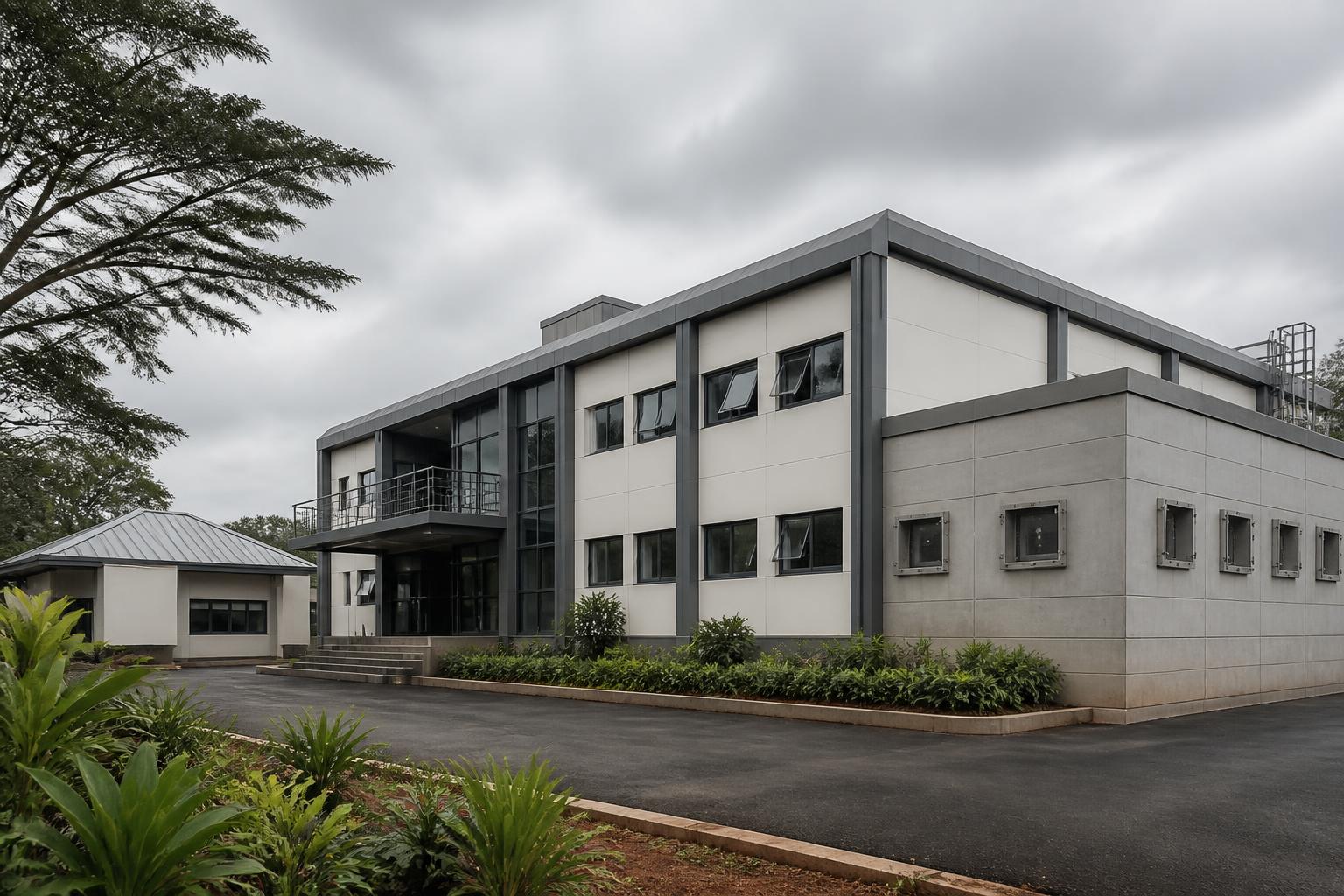
The facility occupies a purpose-built two-story research building and an adjacent single-story field-operations annex within the institutional corridor near the Kenya Medical Research Institute (KEMRI) campus in Nairobi's Upper Hill neighbourhood. The location was selected for its proximity to KEMRI, the WHO Kenya Country Office, and several international NGO headquarters — an environment where a foreign pharmaceutical research centre attracts no particular attention.
Main Research Building — Ground Floor. The ground floor houses the BSL-3 biodefense laboratory: a negative-pressure containment suite configured for pathogen handling, genomic sequencing, and countermeasure assay work. The laboratory receives field-collected biological samples (blood, tissue, environmental swabs) from the Directorate's field-collection network operating across Kenya, Uganda, Tanzania, and the Democratic Republic of Congo. Samples are characterised, sequenced, and tested against the Directorate's countermeasure library. The laboratory is equipped for PCR/qPCR, next-generation sequencing (Illumina and Oxford Nanopore platforms), cell-culture containment, and aerosol-challenge testing in a sealed chamber. The ground floor also contains sample-receiving, decontamination, and cold-storage facilities.
Main Research Building — First Floor. The first floor houses the data-analysis suite, the biodefense intelligence team, and the Directorate coordination office. The biodefense intelligence team synthesises laboratory results, field-surveillance data, and open-source epidemiological reporting into threat assessments that feed PANACEA's biological-risk models. The Directorate coordination office manages the facility's relationship with Singapore and coordinates with Field Operations on African-theatre activities. The first floor operates behind biometric access; no commercial-cover staff have access.
Field-Operations Annex. A single-story building adjacent to the main research building, housing the field-trial coordination team and the logistics desk. The annex manages the Directorate's African field-trial programme: recruitment of trial sites (typically community health centres and district hospitals in rural Kenya and Uganda), protocol design, investigator management, and data collection. The annex also coordinates field-sample collection expeditions and maintains the vehicle fleet (three Toyota Land Cruisers and a refrigerated sample-transport van) used for rural field operations.
Key Systems
BSL-3 Biodefense Laboratory. A negative-pressure containment facility rated for Risk Group 3 pathogens. The laboratory handles live wild-type isolates collected from the field — including influenza variants, coronaviruses, haemorrhagic-fever viruses, and drug-resistant bacterial strains — and tests the Directorate's proprietary countermeasures (vaccines, antivirals, and therapeutic compounds) against them. Laboratory results are reported directly to PANACEA's biological-risk module and to the Site AURORA strain-engineering team, who use wild-type genomic data to validate the stability and specificity of the Directorate's engineered pathogen lines.
Genomic Surveillance Platform. A next-generation sequencing and bioinformatics pipeline that processes field-collected samples within 72 hours of receipt. The platform maintains a continuously updated phylogenetic database of circulating pathogen strains in the East African region, cross-referenced with the Directorate's engineered-strain registry. The system flags any wild-type mutation that approaches the genetic signature of a Directorate-held strain — an early-warning capability designed to detect the scenario the Directorate fears most: a natural pathogen evolving toward convergence with an engineered asset, which could compromise the Directorate's countermeasure exclusivity.
Field-Trial Management System. A protocol-management and data-collection platform that coordinates the Directorate's African field-trial programme. The system manages trial-site recruitment, investigator credentialing, subject enrollment, dose tracking, adverse-event capture, and outcome reporting. Trial data feeds into PANACEA's population-dosing models — providing the Directorate with efficacy and tolerability data from populations that are genetically, nutritionally, and immunologically distinct from the US, European, and East Asian cohorts studied at Bethesda, Rotterdam, and Osaka.
Synaptic Data Fabric — African Node. Nairobi hosts the African regional node of the Directorate's mesh data network. The node operates on a dedicated satellite link to Singapore — the facility does not rely on Kenyan terrestrial internet for classified communications. The satellite link also serves as the data backhaul for field-sample metadata and trial data collected at rural sites with limited connectivity.
Personnel & Security
Approximately 55 personnel are assigned to the Nairobi facility. Of these, 24 hold Directorate-level clearance: the facility director, the biodefense laboratory staff (12 scientists and technicians), the biodefense intelligence team (4 analysts), the Directorate coordination office (3 staff), and the field-trial programme leads (4 staff). The remaining 31 are locally hired commercial employees of Psyon Biosciences East Africa — laboratory assistants, field-research coordinators, drivers, administrative staff, and facilities-maintenance personnel. Commercial-cover staff are told they work for a pharmaceutical research company conducting infectious-disease surveillance and clinical trials in partnership with KEMRI — a plausible and broadly accurate description that omits only the parts that matter.
Physical security is provided by a commercial security company — a uniformed guard post, perimeter fencing, and CCTV, consistent with the institutional norms of the Upper Hill neighbourhood. The BSL-3 laboratory has its own access-control layer (biometric plus airlock entry protocol) that serves both biosafety and information-security requirements. The first floor of the main research building operates behind a secondary biometric layer. Directorate security considerations at the Nairobi facility are less concerned with regulatory scrutiny (Kenyan pharmaceutical regulation lacks the inspection capacity of the FDA, EMA, or PMDA) and more concerned with the operational-security risks specific to East Africa: insider theft of biological samples, physical intrusion, and the potential for locally hired staff to be approached by foreign intelligence services operating in the region — Nairobi hosts a significant concentration of intelligence assets from multiple nations.
Operational Notes
Nairobi was commissioned in 2089, the most recent non-classified facility in the Directorate network. The commissioning decision was driven by two events in 2088: the completion of the gain-of-function contingency stockpile at Singapore, which created an urgent requirement for wild-type validation data from high-pathogen-diversity environments; and the neutralisation of the whistleblower network, which freed operational bandwidth for geographic expansion into a theatre the Directorate had previously assessed as too unpredictable to manage.
The facility's relationship with Site AURORA is its most sensitive operational dimension. Nairobi collects and characterises wild-type pathogens; AURORA engineers pathogens and tests countermeasures in open-atmosphere conditions. The data flow between the two facilities — field genomics from Nairobi informing engineering parameters at AURORA, and AURORA countermeasure candidates returning to Nairobi for wild-type validation — represents the Directorate's most classified bilateral programme. Communications between the facilities transit exclusively through the Singapore Watch Floor; there is no direct link between Nairobi and AURORA.
The African field-trial programme, while operationally productive, carries reputational risk that the Directorate manages carefully. The history of exploitative pharmaceutical trials in Africa is well documented and politically charged. The Directorate's field trials are conducted through legitimate institutional partnerships (KEMRI collaboration agreements, university-hospital MOUs, county-government health-department approvals) and comply with Kenya's Pharmacy and Poisons Board requirements. The trials produce real clinical data, the subjects receive real medical care, and the adverse-event reporting is genuine. The programme's ethical compliance is not a facade — it is a deliberate strategic choice. A scandal involving a foreign pharmaceutical company running irregular trials in East Africa would generate exactly the kind of investigative-journalism attention that could unravel cover operations across the entire Directorate network.