Precursor Manufacturing - Hyderabad
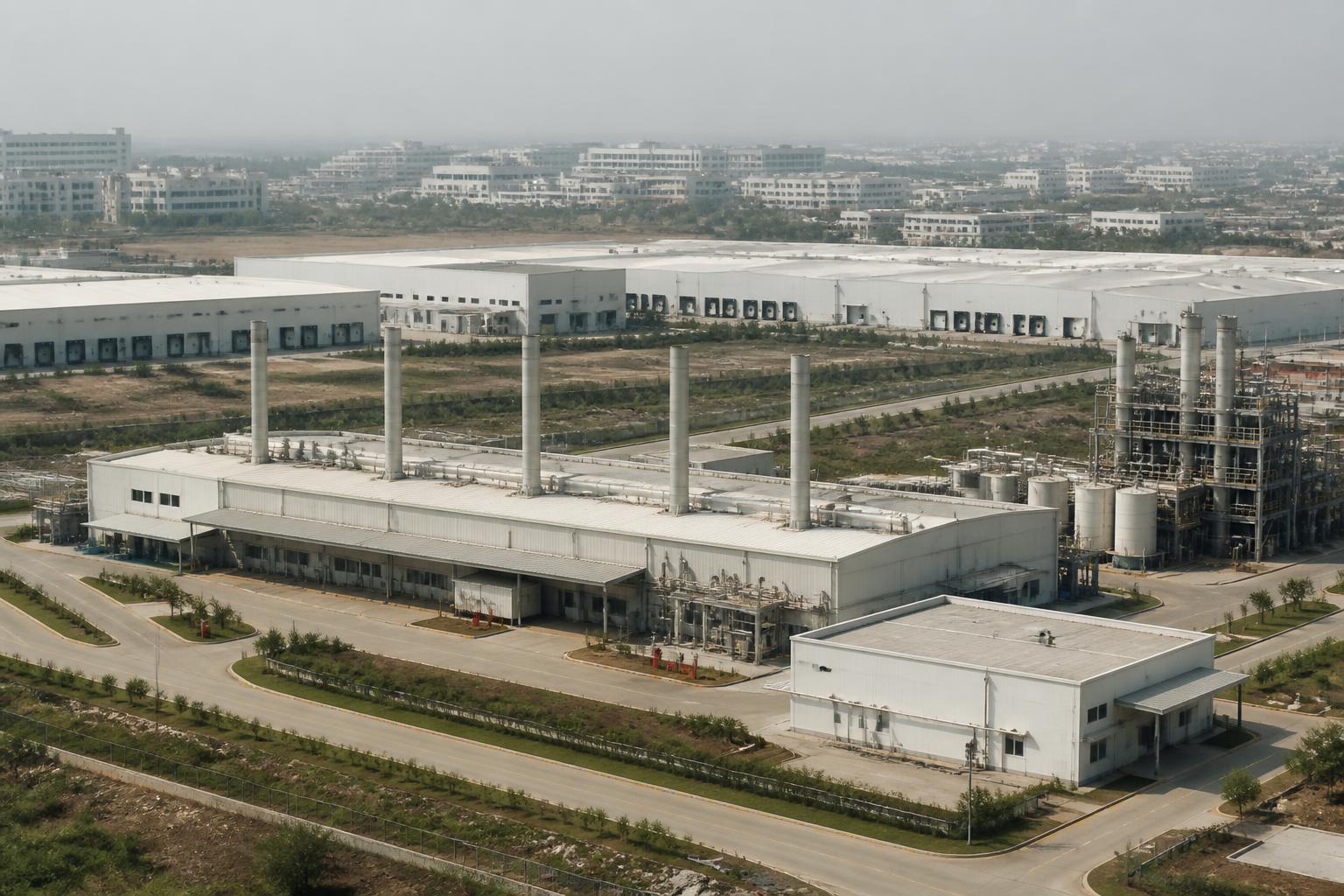
Bulk precursor chemical synthesis and early-stage intermediate production, officially registered as "Psyon Lifesciences India Pvt. Ltd." within the Genome Valley pharmaceutical cluster in Hyderabad's Shamirpet district. The facility is the first link in the Directorate's verticalised supply chain — converting commodity chemicals into the controlled intermediates that feed the Chengdu API facility and the Rotterdam synthesis lines. Without Hyderabad's output, the downstream manufacturing chain stops.
Purpose & Mission
Hyderabad is where the Directorate's pharmaceutical supply chain begins. Every Psyon product — every tablet of Compound-7 dispensed through a clinic, every vial of Lumira loaded into a Vector dispersal unit, every Somnara capsule distributed through the wellness programme — traces its chemical origin to the precursor intermediates synthesised in this facility. The work here is unglamorous: large-scale organic chemistry, solvent-intensive multi-step synthesis, and the relentless quality discipline required to produce intermediates that will survive the next three to five synthetic transformations at Chengdu and Rotterdam without introducing impurities that compromise the classified compound specifications.
India's pharmaceutical-manufacturing ecosystem — the world's largest by volume — provides the operating environment the Directorate needs: a deep labour pool of trained process chemists and chemical engineers, established commodity-chemical supply chains, competitive operating costs, and a regulatory regime (CDSCO) that, while increasingly rigorous for finished-dosage products, applies lighter scrutiny to intermediate manufacturers who do not sell directly to patients. Hyderabad's Genome Valley was selected specifically because a foreign-invested pharmaceutical intermediate manufacturer in this cluster is invisible — one of hundreds.
Physical Description
The facility occupies a 4.2-hectare industrial campus within the Genome Valley Special Economic Zone, a government-designated pharmaceutical and biotech cluster approximately 30 kilometres north of Hyderabad city centre. The campus contains four principal structures: the synthesis plant, the solvent-recovery and waste-treatment facility, the QC laboratory and warehouse complex, and the administrative building.
Synthesis Plant. The largest structure on campus — a single-story industrial building housing six reaction bays, each configured for a specific synthetic pathway. Bays 1–3 handle the initial commodity-to-intermediate conversions: high-volume, high-solvent reactions that transform purchased starting materials (sourced from domestic Indian chemical distributors) into first- and second-stage intermediates. Bays 4–6 perform the more delicate late-stage intermediate synthesis that produces the penultimate compounds shipped to Chengdu for final API conversion. Each bay is independently ventilated, with automated process control, in-line temperature and pH monitoring, and explosion-rated electrical systems. The plant is rated BCL-2.
Solvent Recovery & Waste Treatment. A dedicated facility handling solvent reclamation (the plant consumes and recovers approximately 14,000 litres of organic solvent per month), aqueous waste neutralisation, and solid-waste incineration. Environmental compliance is managed to Central Pollution Control Board standards — a genuine operational requirement, not cover. Environmental violations in the Genome Valley SEZ attract immediate regulatory attention and would compromise the facility's operating licence.
QC Laboratory & Warehouse Complex. The quality-control laboratory performs release testing on every intermediate batch before shipment. Unlike Chengdu, there is no dual-specification testing at Hyderabad — the precursor intermediates are tested against published intermediate specifications only. The classified compound parameters are embedded in the synthesis route itself, not in the intermediate specifications; QC staff at Hyderabad do not know the classified endpoints exist. The warehouse provides temperature-controlled storage for finished intermediates awaiting shipment and raw-material inventory.
Administrative Building. A two-story office building housing site management, HR, finance, the regulatory-affairs desk (CDSCO filings and SEZ compliance), and — on the secured upper floor — a small Directorate coordination team (4 personnel) who manage production scheduling against Singapore's demand signals and oversee supply-chain security.
Key Systems
Reaction Bays 1–6. Six independent synthesis bays with combined monthly output capacity of 3,200 kg of intermediate compounds. Process recipes are received from Singapore via encrypted instruction sets and loaded into the automated process-control system. Production operators execute the recipes as written; the synthesis route encodes the classified specification without exposing it as a separate parameter. This architecture means Hyderabad produces intermediates that meet the classified spec by following what appears to be a standard (if proprietary) synthesis procedure.
Solvent Recovery System. Closed-loop solvent reclamation achieving 87% recovery rate across the six bays. The system reduces both operating cost and environmental-compliance exposure — the two concerns that most frequently trigger regulatory attention for chemical manufacturers in Indian SEZs.
Logistics Coordination Platform. A supply-chain management system that handles inbound raw-material procurement from domestic Indian suppliers, production scheduling across the six bays, batch tracking, and outbound shipment coordination. Finished intermediates are shipped primarily to Chengdu (container freight via Chennai port) and Rotterdam (container freight via Mumbai's Jawaharlal Nehru Port, consistent with the supply route noted in the Rotterdam facility profile). The platform reports production status to PANACEA's supply-chain analytics module.
Environmental Monitoring System. Continuous monitoring of air emissions, water discharge, and soil quality at the campus perimeter, feeding data to both the facility's environmental-compliance team and the Genome Valley SEZ administration. This is not Directorate telemetry — it is a genuine regulatory requirement and a genuine operational priority.
Personnel & Security
Approximately 280 personnel are assigned to the Hyderabad facility — the second-largest headcount in the Directorate network after the Singapore HQ. Of these, only 8 hold Directorate-level clearance: the site coordinator and a three-person Directorate liaison team on the upper floor of the administrative building, plus four embedded quality-assurance personnel who verify that synthesis routes are executed without deviation. The remaining 272 are commercial employees of Psyon Lifesciences India — process chemists, chemical engineers, plant operators, QC analysts, warehouse staff, maintenance crews, and administrative personnel. This is the highest ratio of commercial-cover to Directorate-cleared staff in the entire network, reflecting the facility's design principle: the less the workforce knows, the less there is to protect.
Physical security is provided by a commercial security contractor — standard for Genome Valley tenants. The campus has perimeter fencing, CCTV, vehicle gates, and a 24-hour guard post. The Directorate overlay on the administrative building's upper floor is secured behind badge and biometric access, presented to the rest of the workforce as the "global compliance office" — a designation that explains restricted access without inviting curiosity. No Directorate-classified materials are stored at the facility outside the secured upper floor, and the four embedded QA personnel operate under commercial cover identities.
Operational Notes
Hyderabad was commissioned in 2084, concurrent with the Rotterdam manufacturing facility, because the Directorate's supply-chain architects determined that captive precursor production was a prerequisite for captive API synthesis. The supply chain was designed as a cascade: Hyderabad feeds Chengdu, Chengdu feeds Rotterdam and São Paulo. A disruption at Hyderabad propagates downstream within 60 days as intermediate inventories at Chengdu are depleted.
The facility's operating model deliberately minimises the classified footprint. Synthesis routes are designed so that the classified compound parameters are encoded in the procedure rather than exposed as separate specifications — a chemical-engineering solution to an operational-security problem. The result is a facility where 272 out of 280 staff genuinely do not know they are manufacturing intermediates for anything other than a standard pharmaceutical product line. This is the most secure facility in the network precisely because almost no one there has anything to hide.
The primary operational risk is not regulatory or security — it is industrial. Chemical synthesis at this scale involves flammable solvents, exothermic reactions, and high-pressure systems. A major industrial incident would trigger CDSCO investigation, media attention, and potential SEZ operating-licence review. The Directorate treats industrial safety at Hyderabad as a strategic priority: the maintenance budget is the highest per-employee in the network, and the facility's safety record (zero reportable incidents since commissioning) is maintained by genuine investment, not by classification.