EMA Manufacturing & Compliance - Rotterdam
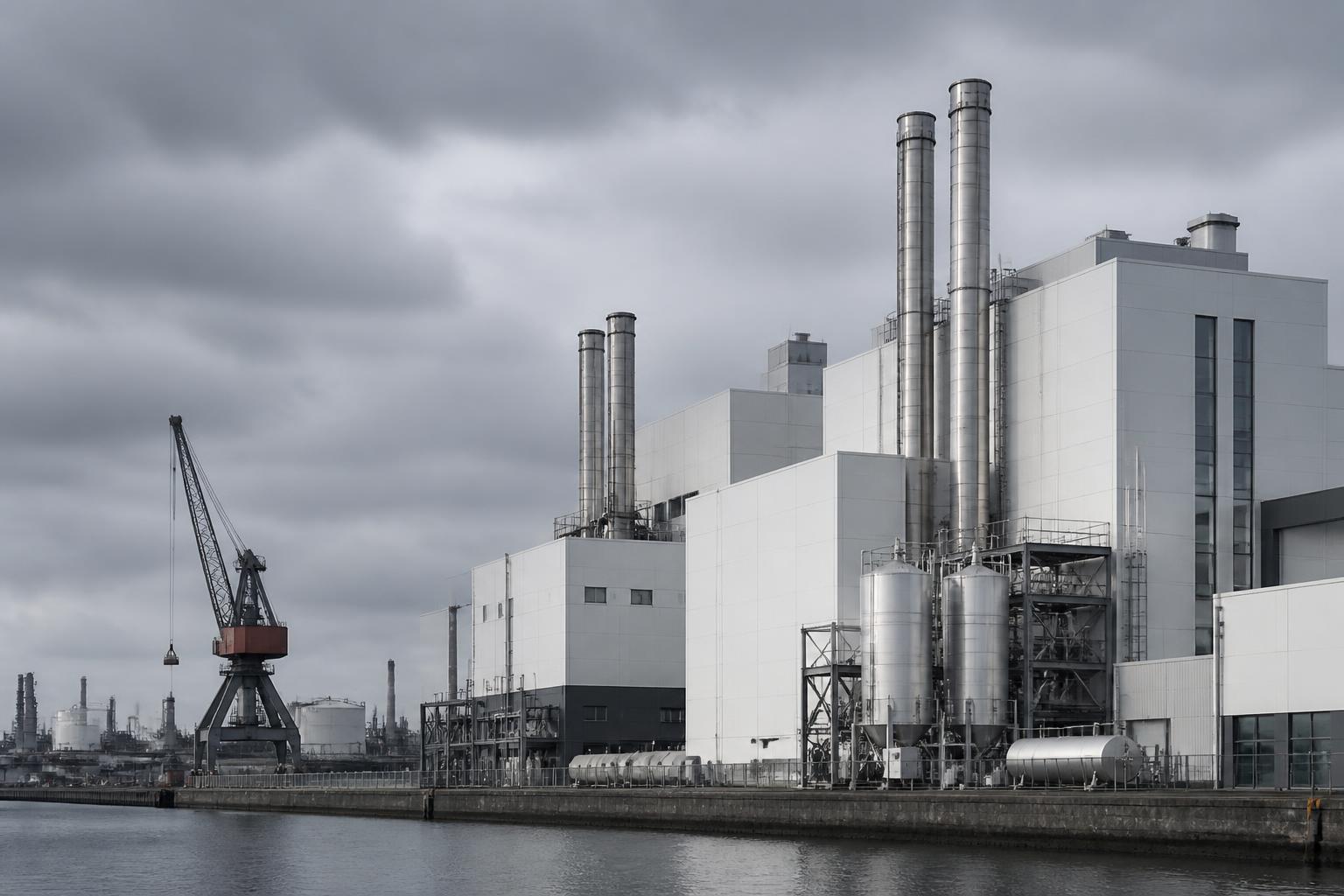
Primary manufacturing facility and European regulatory compliance site for Psyon Biosciences. The Rotterdam plant houses the large-scale synthesis lines for Compound-7, Lumira, and Somnara, the cold-chain distribution hub serving 14 EU distribution points, and the European Medicines Agency liaison office that keeps the Directorate's commercial products on the approved-medicines register.
Purpose & Mission
Rotterdam is the Directorate's production engine and its European regulatory face. The facility exists to accomplish two objectives that are operationally inseparable: first, to manufacture the pharmaceutical compounds that constitute the Directorate's commercial revenue stream and its primary vector for population-level influence; second, to maintain the regulatory standing — EMA marketing authorizations, GMP certifications, pharmacovigilance filings — that allows those compounds to be legally distributed across 27 EU member states without attracting the scrutiny that an unregistered or non-compliant manufacturer would invite.
The commercial manufacturing operation is genuine. The compounds produced here are real pharmaceutical products, manufactured to GMP standards, subjected to quality-control assay, and released through a documented batch-release process. What the EMA does not see is the classified specification layer beneath the published formulations — the behavioural-modulation profiles, the Halo-compatibility parameters, and the population-dosing telemetry that flows back to PANACEA through the Synaptic Data Fabric.
Physical Description
The Rotterdam facility occupies a purpose-built industrial campus in the Botlek port-industrial zone, approximately 12 kilometres southwest of Rotterdam city centre. The campus comprises three principal structures: the synthesis building, the distribution centre, and the administrative block.
Synthesis Building. A two-story GMP-rated manufacturing facility housing Synthesis Lab A and Synthesis Lab B — the two main production lines. Lab A produces Compound-7 and Lumira; Lab B produces Somnara and handles overflow and reformulation runs. Each lab operates as an independent clean-room environment with dedicated HVAC, water-for-injection systems, and waste-treatment capability. The synthesis building is rated BCL-2 and is subject to scheduled EMA inspection.
Distribution Centre. A temperature-controlled logistics facility adjacent to the synthesis building. The centre operates the Directorate's European cold-chain distribution network — refrigerated trucks dispatch nightly to 14 EU distribution points, with real-time temperature and chain-of-custody telemetry feeding into the Synaptic Data Fabric. The distribution centre is rated BCL-1.
Administrative Block. A three-story office building housing the EMA liaison office, quality-assurance documentation, the Rotterdam site management team, and — on the secured third floor — the Directorate overlay: the classified operations staff who manage production scheduling against PANACEA's population-dosing models, coordinate with Singapore on formulation specifications, and handle the regulatory-capture relationship with EMA inspectors.
Key Systems
Synthesis Lab A. Primary production line for Compound-7 and Lumira. Automated continuous-flow synthesis with in-line analytical monitoring (HPLC, mass spectrometry). Batch capacity: 2,400 kg/month of finished product. All batch records are dual-filed — GMP-compliant records for EMA, and classified formulation records for PANACEA.
Synthesis Lab B. Secondary production line handling Somnara and flexible-capacity runs. Same instrumentation as Lab A, with additional capability for small-batch reformulation work when Singapore requests modified compound profiles for specific population cohorts.
Cold-Chain Distribution Hub. 14-route European distribution network operating on a nightly dispatch cycle. Each shipment carries GPS tracking, continuous temperature logging, and tamper-evident seals. Distribution data feeds into PANACEA's supply-chain analytics for real-time inventory and penetration modelling.
Synaptic Data Fabric — European Node. Rotterdam hosts the European regional node of the Directorate's data network, providing local-latency access to PANACEA dashboards, production telemetry, and distribution tracking for European operations staff. The node maintains encrypted replication to the Singapore core.
Personnel & Security
Approximately 310 personnel are assigned to the Rotterdam facility. Of these, 60 hold Directorate-level clearance and are aware of the organization's full mission and the classified dimensions of the manufacturing programme. The remaining 250 staff are commercial manufacturing employees of Psyon Biosciences B.V. — chemists, process engineers, quality-control analysts, logistics operators, and administrative staff — who operate under the genuine belief that they work for a mid-tier European pharmaceutical manufacturer.
Security follows a layered model. The campus perimeter is secured by commercial-grade access control (badge, CCTV, vehicle barriers) consistent with pharmaceutical industry norms and sufficient to satisfy EMA physical-security requirements. The Directorate overlay — covering the third floor of the administrative block and the classified network infrastructure — operates behind a secondary access layer requiring biometric authentication and Halo verification. Directorate security personnel are embedded within the commercial security team and are not identifiable to non-cleared staff.
The facility operates under Dutch law and is subject to unannounced EMA inspection. The Directorate's regulatory-capture programme ensures that inspections are managed, but the manufacturing operation must withstand genuine scrutiny — the commercial product is real, the GMP compliance is real, and the quality records are audit-ready at all times.
Operational Notes
Rotterdam was commissioned in 2084, one year after the Singapore Operations Core, to establish the Directorate's European manufacturing and distribution capability. The Botlek site was selected for its proximity to the Port of Rotterdam (facilitating bulk API import from the Hyderabad precursor facility), its location within the EU regulatory perimeter, and the availability of a skilled pharmaceutical workforce.
The facility also serves as the PANACEA secondary compute node — in the event of a catastrophic loss of the Singapore primary cluster, Rotterdam can assume computational continuity for critical Directorate systems within 90 minutes. This failover capability is tested quarterly.
Rotterdam's dual nature — genuine manufacturer and Directorate asset — makes it the most inspection-exposed facility in the network. The site's commercial legitimacy is its best security: it is easier to hide classified operations inside a functioning, compliant pharmaceutical plant than to explain why a pharmaceutical company has no functioning plant at all.